

Ship Canopy: Difference between revisions
Oh, they finished it all right... |
Reworded and rearranged large parts of the article to remove word cruft, replace archaic/redundant/irrelevant text and odd phrases, and place more focus on what a canopy is and less on what a broken canopy is. |
||
| Line 1: | Line 1: | ||
[[File: |
[[File:CobraV_Canopy.png|thumb|right|384px|The canopy of a [[Cobra Mk V]], reflecting illumination from a landing pad's spotlight.]] |
||
The '''canopy''' is the transparent enclosure over the [[ship]] cockpit. |
The '''ship canopy''' is the transparent, tinted enclosure over the [[ship]]'s cockpit. It protects the [[pilot]] and cockpit from radiation and other hazards. |
||
== HUD == |
== HUD == |
||
Much of the upper [[HUD]] is displayed or projected on the canopy. This includes active weapon group, currently selected target and information, supercruise orbit lines and object markers, and weapon targeting |
Much of the upper [[HUD]] is displayed or projected on the canopy. This includes the active weapon group, currently selected target and information, [[supercruise]] orbit lines and object markers, and weapon targeting reticles. Alerts (i.e. heat warnings, incoming missiles, etc.) are also shown on the canopy. |
||
If the canopy is shattered, all information displayed on it will be lost. It still exists (i.e. missiles will still lock on, gimballed weapons will still track), but is no longer visible to the pilot unless viewed from an intact fragment (e.g. a canopy shattered in front will still remain functional from the sides). All auditory cues from [[COVAS]] are muffled. More critically, the escape vector for supercruise from gravitational wells and escaping [[interdiction]] will not be visible. |
|||
| ⚫ | |||
Loss of canopy HUD, apart from being potentially lethal, can also be highly detrimental for pilots who keep fighting for precious minutes more before they go to a station for repair, especially with fixed weapons. |
|||
The lack of supercruise target distance and arrival time estimate can also make it difficult for a pilot to judge whether they will have enough time to get to a chosen repair destination or even when they are close enough to safely drop out of supercruise. Pilots with shattered canopies are advised always to seek the nearest port with repair facilities and a pad able to accommodate their ship as soon as possible, although naturally some pilots are more impetuous than others. |
|||
== Size == |
== Size == |
||
The size and viewing arc of the canopy depends on the model of ship. A bigger canopy gives better all |
The size and viewing arc of the canopy depends on the model of ship. A bigger canopy gives better all-round vision which is useful for [[combat]] and sightseeing, but also increases the likelihood of it taking damage. This is especially the case when fighting enemies armed with explosive weapons such as [[Missile Rack]]s, as the area effect means that even glancing hits can very easily damage or outright breach a ship's canopy. |
||
[[Module Reinforcement Package]]s |
[[Module Reinforcement Package]]s can reduce incoming canopy damage, but some ships have more vulnerable canopies due to their size in relation to the rest of the ship, ship layout, or even just the kind of combat style enforced by the ship's flight characteristics. Ships notorious for having a canopy that is easily breached, even during light combat, include the [[Asp Explorer]] and [[Vulture]]—both ships have large, bubble canopies that make easy targets. |
||
== Audio and visual effects == |
== Audio and visual effects == |
||
=== Sound === |
=== Sound === |
||
Sound requires solids, liquids, or gasses to travel through. Since space is a vacuum, there is no matter through which sound can travel. The speaker array inside the cockpit of a [[ship]] simulates all audio activity outside the ship in real-time, thus creating the illusion that the pilot can hear sounds in space. When the canopy |
Sound requires solids, liquids, or gasses to travel through. Since space is a vacuum, there is no matter through which sound can travel. The speaker array inside the cockpit of a [[ship]] simulates all audio activity outside the ship in real-time, thus creating the illusion that the pilot can hear sounds in space. When the canopy is breached and the ship's atmosphere is vented, sound no longer has any air to travel through, rendering the speakers useless. At this point, the pilot can only hear their own breathing, as well as muffled [[COVAS]] alerts, until they repair their canopy.<ref>[https://community.elitedangerous.com/en/node/274 Matthew Florianz, Senior Sound Designer on Elite Dangerous]</ref> |
||
| ⚫ | |||
[[File:Anaconda-Broken-Canopy.png|thumb|256px|A broken canopy on an [[Anaconda]]. Note the tint from the canopy section that has not been vented into space.]] |
|||
The canopy can be damaged by trauma from impacts, hull stress (e.g. an emergency FSD drop), severe gravitational hazards, and weapons fire. Sufficient damage to the canopy will result in visible and audible cracking. This will worsen as more damage is taken, until the canopy is breached, whereupon it shatters dramatically. In the most extreme cases, such as a high-speed asteroid collision or [[wikipedia:Controlled flight into terrain|CFIT]], it is possible for an otherwise intact ship canopy to be instantly breached upon impact. |
|||
When the ship's canopy shatters, the ship's internal atmosphere will be vented into space, a Remlok Survival Mask instantly deploys from the pilot's suit to protect the wearer against oxygen depletion and the vacuum of space, and any HUD information that was previously projected onto the parts of the canopy that have shattered may no longer be viewable unless they are projected onto a canopy fragment. The HUD itself is still functioning, however—gimballed weapons will still track targets and missiles will still lock on normally. |
|||
While the breaching of the ship's canopy is not dangerous in itself, the loss of HUD projection and activation of the ship's [[Life Support]] module makes most space-borne activities much more difficult—escape vectors and target indicators may not be visible, making it challenging for the pilot to continue combat, especially with fixed weapons, and judge whether there is enough time to get to a chosen repair destination or even if the ship is close enough to the destination to safely drop out of supercruise. Complete depletion of the ship's emergency oxygen supply from the Life Support module will also result in the destruction of the ship. |
|||
| ⚫ | |||
The canopy can be damaged by trauma such as impacts, hull stresses (for example, an emergency FSD drop), severe gravitational hazards and weapons fire. Damage to the canopy, once sufficiently severe, results in visible and audible cracking. This will worsen if more damage is taken, until the canopy dramatically shatters. If this happens, the ship's atmosphere will vanish into space. A Remlok Survival Mask instantly deploys from the pilot's suit to protect the wearer against oxygen depletion and the vacuum of space. This however leaves the pilot with a limited time to reach a [[station]] for repairs. As noted above, sound no longer has air to resonate with so it becomes quiet.<ref>[https://community.elitedangerous.com/en/node/274 Matthew Florianz. Senior Sound Designer on Elite Dangerous]</ref> |
|||
=== Ice buildup === |
=== Ice buildup === |
||
[[File:ED-Orca-spaceship-cockpit-sideview.png|thumb|256px| |
[[File:ED-Orca-spaceship-cockpit-sideview.png|thumb|256px|Ice formation on the edges of an [[Orca]]'s canopy.]] |
||
Ice starts forming on the canopy if the ship's [[Heat|temperature]] falls below 10%, which can occur after shutting down [[modules]] or dropping a [[Heatsink Launcher|heatsink]]. Ice presents no danger, and is simply a cosmetic effect. |
Ice starts forming on the canopy if the ship's [[Heat|temperature]] falls below 10%, which can occur after shutting down [[modules]] or dropping a [[Heatsink Launcher|heatsink]]. Ice presents no danger, and is simply a cosmetic effect. |
||
=== Scratch marks === |
=== Scratch marks === |
||
[[File:Mandalay_Canopy-ScratchMarks.png|thumb|256px|Scratch marks on a Mandalay's canopy]] |
[[File:Mandalay_Canopy-ScratchMarks.png|thumb|256px|Scratch marks on a [[Mandalay]]'s canopy.]] |
||
At lower paint integrity levels, scratch marks will start to appear on the canopy, visible at angles where light is reflected off the ship's interior. The scratch marks will be removed upon restoring the ship's paint through Advanced Maintenance services. Similar to ice buildup, scratch marks present no danger and are merely a cosmetic effect. |
At lower paint integrity levels, scratch marks will start to appear on the canopy, visible at angles where light is reflected off the ship's interior. The scratch marks will be removed upon restoring the ship's paint integrity through Advanced Maintenance services. Similar to ice buildup, scratch marks present no danger and are merely a cosmetic effect. |
||
=== Steam condensation === |
=== Steam condensation === |
||
[[File:KestrelMkII_Canopy-SteamCondensation.png|thumb|256px|Steam condensation on the edges of a Kestrel Mk II's canopy]] |
[[File:KestrelMkII_Canopy-SteamCondensation.png|thumb|256px|Steam condensation on the edges of a [[Kestrel Mk II]]'s canopy.]] |
||
On certain ships, such as the |
On certain ships, such as the Kestrel Mk II and [[Lynx Highliner]], steam will start clouding the edges of the canopy with condensation once the ship is above 100% heat. The condensation will disappear when the ship's heat drops below 100%. While steam condensation on its own is a cosmetic effect, seeing it is an indication that the ship is overheating and taking module (and, above 150% heat, hull) damage. |
||
== Surviving a |
== Surviving a breached canopy == |
||
If the pilot is not able to reach a station before |
If the pilot is not able to reach a station before their [[Life Support]] module's emergency oxygen runs out, their ship will self-destruct and they will be forced to [[Redeployment|redeploy]]. The available breathable oxygen time depends on the rating of the ship's Life Support module, ranging from 5 minutes (for an E-rated module) to 25 minutes (for an A-rated module). The Life Support module's oxygen supply can also be refilled via [[Synthesis]], which requires 2 [[Iron]] and 1 [[Nickel]] per refill. Pilots with large stockpiles of both [[Materials]] can thus replenish their Life Support module repeatedly and potentially continue traveling with a broken canopy for hours. Synthesis requires a brief activation period before the refill takes effect, however, and Life Support cannot be "over-filled" by repeating the refill process in quick succession. Generally, it is recommended for pilots with breached ship canopies to immediately divert to the nearest station with repair facilities and a pad able to accommodate their ship as soon as possible. |
||
Passing through the force field in a [[Starport]]'s [[Access Corridor]] or entering the [[Landing Pad]] hangar on an [[Outpost]], [[Drake-Class Carrier|Fleet Carrier]], or [[Surface Port]] will return the ship to a breathable oxygen atmosphere and halt the countdown, though |
Passing through the force field in a [[Starport]]'s [[Access Corridor]] or entering the [[Landing Pad]] hangar on an [[Outpost]], [[Drake-Class Carrier|Fleet Carrier]], or [[Surface Port]] will return the ship to a breathable oxygen atmosphere and halt the countdown, though it will restart if the canopy is not repaired and the ship returns to vacuum. Docking with a starport will also immediately refill the Life Support module's oxygen supply. |
||
A damaged, unbroken canopy can be repaired outside of a station either by use of an [[Auto Field-Maintenance Unit]] or [[Limpet Controller |
A damaged, unbroken canopy can be repaired outside of a station either by use of an [[Auto Field-Maintenance Unit]] or [[Repair Limpet Controller]], but once completely shattered it can only be repaired at a facility with Landing Pads and repair services. A shattered canopy far away from inhabited space will usually therefore result in the loss of the ship, and experienced [[explorer]]s are known to keep close track of their canopy's status. |
||
== Notes == |
== Notes == |
||
* |
* In ''[[Elite Dangerous: Odyssey]]'', it is not possible to [[On Foot|disembark]] from a ship onto the surface of a planet if the ship's canopy is breached. |
||
*Despite being located on the outside of the ship, the Canopy is considered an internal module for [[Module Reinforcement Package|Module Reinforcement]] protection. |
* Despite being located on the outside of the ship, the Canopy is considered an internal module for [[Module Reinforcement Package|Module Reinforcement]] protection. |
||
== Trivia == |
== Trivia == |
||
*A mock-up screenshot of the steam condensation effect was previewed during the ''Elite Dangerous'' beta period in 2014.<ref>[https://www.reddit.com/r/EliteDangerous/comments/51t51f/remember_the_window_condensation_while_fuel/ r/EliteDangerous: Remember the window condensation while fuel scooping?]</ref> |
* A mock-up screenshot of the steam condensation effect was previewed during the ''Elite Dangerous'' beta period in 2014.<ref>[https://www.reddit.com/r/EliteDangerous/comments/51t51f/remember_the_window_condensation_while_fuel/ r/EliteDangerous: Remember the window condensation while fuel scooping?]</ref> |
||
*The fastest way to break a canopy is to drop into the cones of a neutron [[star]] or white dwarf and wait for 30 seconds. |
|||
== Videos == |
== Videos == |
||
| Line 58: | Line 55: | ||
File:Elite dangerous vr canopy breach|[[Krait Mk II]] (VR) |
File:Elite dangerous vr canopy breach|[[Krait Mk II]] (VR) |
||
File:Elite Dangerous - Canopy Breach|[[Imperial Cutter]] |
File:Elite Dangerous - Canopy Breach|[[Imperial Cutter]] |
||
| ⚫ | |||
</gallery> |
</gallery> |
||
Revision as of 04:43, 24 May 2026

The ship canopy is the transparent, tinted enclosure over the ship's cockpit. It protects the pilot and cockpit from radiation and other hazards.
HUD
Much of the upper HUD is displayed or projected on the canopy. This includes the active weapon group, currently selected target and information, supercruise orbit lines and object markers, and weapon targeting reticles. Alerts (i.e. heat warnings, incoming missiles, etc.) are also shown on the canopy.
Size
The size and viewing arc of the canopy depends on the model of ship. A bigger canopy gives better all-round vision which is useful for combat and sightseeing, but also increases the likelihood of it taking damage. This is especially the case when fighting enemies armed with explosive weapons such as Missile Racks, as the area effect means that even glancing hits can very easily damage or outright breach a ship's canopy.
Module Reinforcement Packages can reduce incoming canopy damage, but some ships have more vulnerable canopies due to their size in relation to the rest of the ship, ship layout, or even just the kind of combat style enforced by the ship's flight characteristics. Ships notorious for having a canopy that is easily breached, even during light combat, include the Asp Explorer and Vulture—both ships have large, bubble canopies that make easy targets.
Audio and visual effects
Sound
Sound requires solids, liquids, or gasses to travel through. Since space is a vacuum, there is no matter through which sound can travel. The speaker array inside the cockpit of a ship simulates all audio activity outside the ship in real-time, thus creating the illusion that the pilot can hear sounds in space. When the canopy is breached and the ship's atmosphere is vented, sound no longer has any air to travel through, rendering the speakers useless. At this point, the pilot can only hear their own breathing, as well as muffled COVAS alerts, until they repair their canopy.[1]
Cracking and breaching

The canopy can be damaged by trauma from impacts, hull stress (e.g. an emergency FSD drop), severe gravitational hazards, and weapons fire. Sufficient damage to the canopy will result in visible and audible cracking. This will worsen as more damage is taken, until the canopy is breached, whereupon it shatters dramatically. In the most extreme cases, such as a high-speed asteroid collision or CFIT, it is possible for an otherwise intact ship canopy to be instantly breached upon impact.
When the ship's canopy shatters, the ship's internal atmosphere will be vented into space, a Remlok Survival Mask instantly deploys from the pilot's suit to protect the wearer against oxygen depletion and the vacuum of space, and any HUD information that was previously projected onto the parts of the canopy that have shattered may no longer be viewable unless they are projected onto a canopy fragment. The HUD itself is still functioning, however—gimballed weapons will still track targets and missiles will still lock on normally.
While the breaching of the ship's canopy is not dangerous in itself, the loss of HUD projection and activation of the ship's Life Support module makes most space-borne activities much more difficult—escape vectors and target indicators may not be visible, making it challenging for the pilot to continue combat, especially with fixed weapons, and judge whether there is enough time to get to a chosen repair destination or even if the ship is close enough to the destination to safely drop out of supercruise. Complete depletion of the ship's emergency oxygen supply from the Life Support module will also result in the destruction of the ship.
Ice buildup

Ice starts forming on the canopy if the ship's temperature falls below 10%, which can occur after shutting down modules or dropping a heatsink. Ice presents no danger, and is simply a cosmetic effect.
Scratch marks

At lower paint integrity levels, scratch marks will start to appear on the canopy, visible at angles where light is reflected off the ship's interior. The scratch marks will be removed upon restoring the ship's paint integrity through Advanced Maintenance services. Similar to ice buildup, scratch marks present no danger and are merely a cosmetic effect.
Steam condensation

On certain ships, such as the Kestrel Mk II and Lynx Highliner, steam will start clouding the edges of the canopy with condensation once the ship is above 100% heat. The condensation will disappear when the ship's heat drops below 100%. While steam condensation on its own is a cosmetic effect, seeing it is an indication that the ship is overheating and taking module (and, above 150% heat, hull) damage.
Surviving a breached canopy
If the pilot is not able to reach a station before their Life Support module's emergency oxygen runs out, their ship will self-destruct and they will be forced to redeploy. The available breathable oxygen time depends on the rating of the ship's Life Support module, ranging from 5 minutes (for an E-rated module) to 25 minutes (for an A-rated module). The Life Support module's oxygen supply can also be refilled via Synthesis, which requires 2 Iron and 1 Nickel per refill. Pilots with large stockpiles of both Materials can thus replenish their Life Support module repeatedly and potentially continue traveling with a broken canopy for hours. Synthesis requires a brief activation period before the refill takes effect, however, and Life Support cannot be "over-filled" by repeating the refill process in quick succession. Generally, it is recommended for pilots with breached ship canopies to immediately divert to the nearest station with repair facilities and a pad able to accommodate their ship as soon as possible.
Passing through the force field in a Starport's Access Corridor or entering the Landing Pad hangar on an Outpost, Fleet Carrier, or Surface Port will return the ship to a breathable oxygen atmosphere and halt the countdown, though it will restart if the canopy is not repaired and the ship returns to vacuum. Docking with a starport will also immediately refill the Life Support module's oxygen supply.
A damaged, unbroken canopy can be repaired outside of a station either by use of an Auto Field-Maintenance Unit or Repair Limpet Controller, but once completely shattered it can only be repaired at a facility with Landing Pads and repair services. A shattered canopy far away from inhabited space will usually therefore result in the loss of the ship, and experienced explorers are known to keep close track of their canopy's status.
Notes
- In Elite Dangerous: Odyssey, it is not possible to disembark from a ship onto the surface of a planet if the ship's canopy is breached.
- Despite being located on the outside of the ship, the Canopy is considered an internal module for Module Reinforcement protection.
Trivia
- A mock-up screenshot of the steam condensation effect was previewed during the Elite Dangerous beta period in 2014.[2]
Videos
-
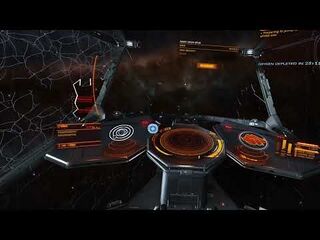 Krait Mk II (VR)
-
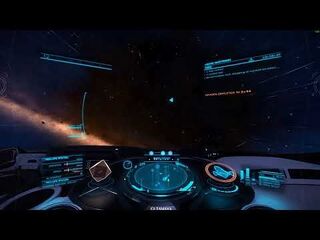 Elite Dangerous - Canopy Breach
-
 A broken canopy on a Python.
